

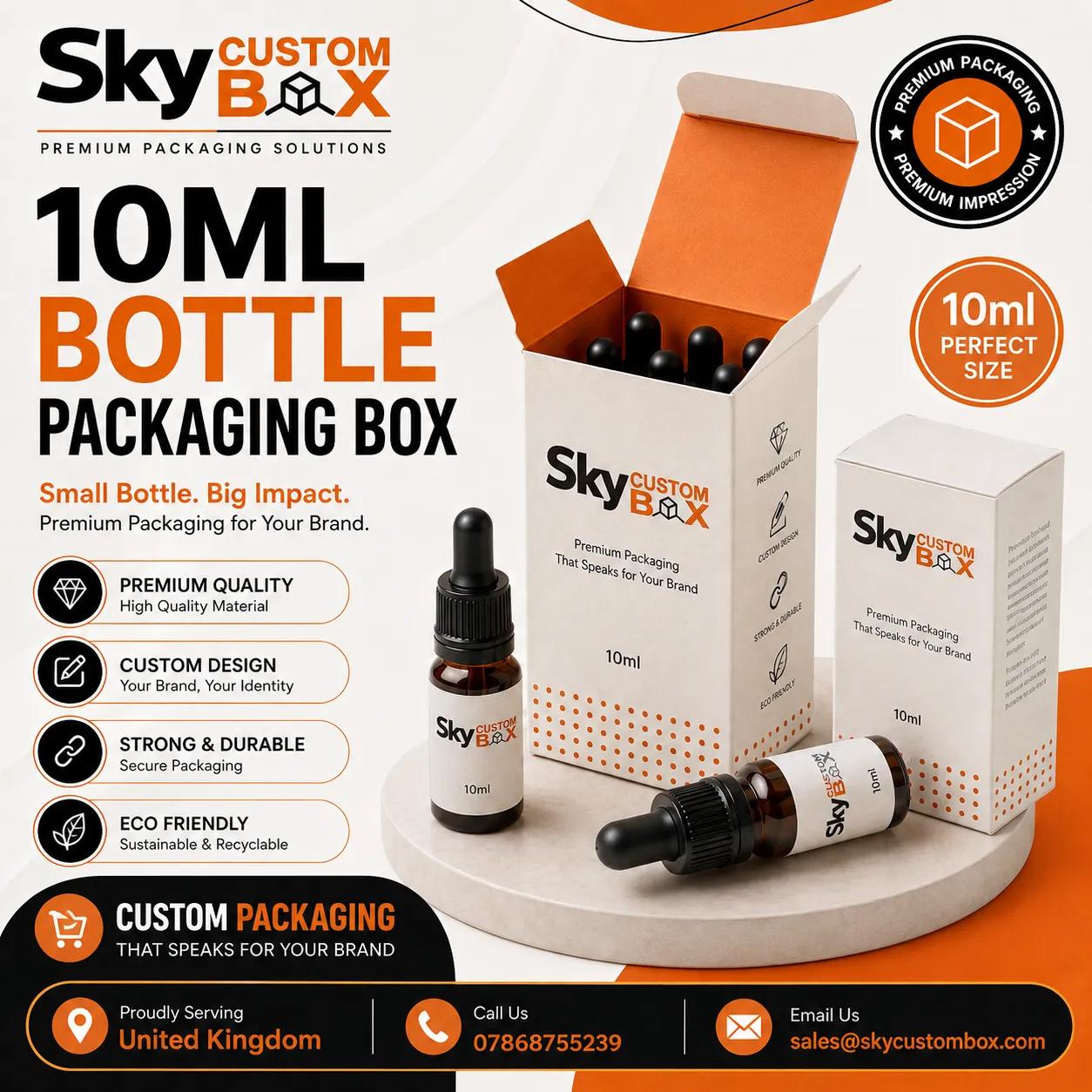
boxes for 10ml bottles
Small bottles may contain only a few millilitres of product, but their packaging plays a surprisingly important role in protection, presentation, and customer experience. From essential oils and fragrances to serums, cosmetic products, samples, and specialist liquids, 10ml bottles need packaging that is appropriately sized and carefully designed.
Well-designed 10ml bottle packaging box solutions can help prevent damage during handling while giving small products a more organised and professional appearance. The right packaging also provides space for branding, product information, instructions, and regulatory details without making the package unnecessarily bulky.
As businesses increasingly focus on sustainable materials, efficient shipping, and attractive retail presentation, packaging for small bottles has become more sophisticated. Understanding the available options can help manufacturers, retailers, and small businesses make practical packaging decisions.
Why Packaging Matters for 10ml Bottles
A 10ml bottle is compact and often made from glass, plastic, or another relatively lightweight material. Despite its small size, the bottle may be vulnerable to scratches, breakage, leakage, or movement during transportation.
A suitable box creates a protective layer around the container. Internal dimensions should be carefully considered so the bottle does not move excessively inside the package.
Good packaging can provide several practical benefits:
Protection from knocks and impacts
Reduced movement during transportation
Better shelf presentation
Space for product information
Improved brand recognition
Easier storage and handling
More organised presentation for gift sets or samples
Packaging also acts as an important communication tool. A simple carton can display a product name, ingredients, usage instructions, company details, barcode, batch information, and other relevant information.
For retailers, this makes packaging more than just a protective container. It becomes part of the overall product experience.
Choosing the Right Boxes for 10ml Bottles
When selecting boxes for 10ml bottles, size is one of the first factors to consider. A box that is too large can allow the bottle to move around, increasing the risk of damage. On the other hand, a box that is too tight may make inserting and removing the bottle difficult.
The internal dimensions should account for the bottle's height, diameter, closure, label, and any additional protective insert.
Different closure styles can also affect the required box dimensions. For example, a bottle with a dropper, spray pump, rollerball, or specialised cap may need additional clearance at the top.
Businesses should also consider how the packaging will be handled. A bottle intended for individual retail display may have different requirements from one shipped as part of an online order.
Important factors include:
Bottle dimensions: Measure the bottle itself rather than relying solely on the nominal capacity. Two 10ml bottles can have different shapes and dimensions.
Material: Glass bottles generally require greater protection than flexible plastic containers.
Closure type: Droppers, pumps, sprays, and caps can affect the overall height of the packaged product.
Internal protection: Inserts, dividers, or fitted supports can help keep bottles secure.
Opening style: Tuck-end cartons, sleeve boxes, and other formats provide different customer experiences.
Printing requirements: Consider whether the package needs simple identification or detailed branding and product information.
Careful measurement before production can reduce wasted material and prevent problems during filling, packing, and distribution.
From 10ml to 30ml: Matching Packaging to Product Size
Although 10ml bottles are common for samples, travel-sized products, essential oils, and concentrated formulations, many brands also use larger containers. A 30ml bottle box, for example, needs to accommodate a different bottle profile while maintaining similar principles of protection and presentation.
It is important not to assume that packaging can simply be scaled proportionally according to bottle capacity. A 30ml bottle may have a different height-to-width ratio, closure mechanism, or shoulder shape.
This is particularly relevant for businesses selling product ranges. A consistent packaging design can create a recognisable visual identity across multiple bottle sizes while using appropriately sized cartons.
For example, a brand might offer:
10ml sample or travel bottles
15ml specialist products
30ml standard retail bottles
50ml or larger premium products
Using a coordinated packaging system allows the visual identity to remain consistent while each box is engineered for its specific container.
Current Trends in Small-Bottle Packaging
Packaging trends have increasingly moved towards sustainability, minimalism, and functional design. Consumers are paying more attention to the materials used around products, while businesses are looking for ways to reduce unnecessary packaging.
One major trend is the use of recyclable paperboard and kraft-style packaging. These materials can provide a natural appearance while supporting lightweight packaging structures.
Minimalist printing is another growing design direction. Instead of covering every available surface with graphics, brands may use restrained typography, limited colours, and clear product information.
Window packaging is also used for products where visual presentation is important. A transparent window can allow customers to see the bottle without opening the package.
Other notable trends include:
Recyclable and paper-based materials
Reduced packaging dimensions
Minimalist visual design
Custom-fit internal structures
Clear product labelling
QR codes for additional product information
Packaging designed for e-commerce shipping
However, sustainability should be considered alongside performance. A packaging material should be suitable for the product, transportation conditions, storage requirements, and expected handling environment.
Common Packaging Challenges and Practical Solutions
Small-bottle packaging can present several challenges. One of the most common is excessive internal space. If the bottle can move freely inside the carton, repeated movement during transportation may increase the possibility of damage.
A correctly sized carton or internal insert can address this issue.
Another challenge is balancing protection with material usage. Adding excessive layers of packaging may provide additional protection but can increase costs, storage requirements, and environmental impact.
A more efficient approach is to identify where protection is genuinely required and design the package around those requirements.
Challenge: Bottle movement
Solution: Use a closer-fitting box or an appropriately designed insert to limit movement.
Challenge: Glass breakage
Solution: Consider stronger board grades, protective inserts, and appropriate shipping cartons for fragile products.
Challenge: Poor shelf presentation
Solution: Use clear typography, consistent branding, and packaging proportions that complement the bottle.
Challenge: Excessive packaging waste
Solution: Review the box dimensions and remove unnecessary material while maintaining adequate protection.
Challenge: Limited space for product information
Solution: Prioritise essential information on the carton and use QR codes where appropriate to provide access to additional digital content.
These practical considerations are particularly important for online retailers because packaging has to survive a supply chain that may involve multiple handling points.
Packaging for Different Product Applications
10ml bottle packaging is used across a wide range of industries. Cosmetics and personal-care businesses may use small bottles for facial serums, fragrance oils, beauty treatments, and concentrated formulas.
Essential oil businesses frequently use compact bottles because customers may purchase several varieties at once. Individual cartons can make products easier to identify and provide useful information about ingredients and usage.
Small bottles are also common in:
Aromatherapy products
Perfume and fragrance samples
Cosmetic serums
Beard and grooming oils
Pharmaceutical and healthcare-related products
Laboratory samples
Travel-size products
Gift sets
Promotional product samples
Each application can have different packaging requirements. A premium fragrance sample may prioritise visual appearance, while a laboratory product may place greater emphasis on identification and handling information.
This demonstrates why packaging should be designed around the product's actual use rather than relying on a generic box format.
How Businesses Can Improve Their Packaging Decisions
Before finalising a packaging design, businesses should create a clear specification. This should include the bottle's exact dimensions, material, closure type, weight, quantity per shipment, and intended sales channel.
It is also useful to test packaging before committing to a large production run. Physical samples can reveal problems that may not be obvious in digital designs.
A practical evaluation should consider:
Does the bottle fit securely?
Can it be inserted and removed easily?
Does the carton protect the bottle during handling?
Is the package appropriately sized?
Is important product information easy to read?
Does the design work on a retail shelf?
Can the packaging be stored and transported efficiently?
Are the selected materials appropriate for the intended disposal or recycling route?
Packaging specialists such as Sky Custom Box, with locations in Kington and Birmingham, can be considered when businesses are exploring custom packaging formats and material options.
The goal is not simply to create an attractive box. Effective packaging combines structural performance, usability, visual communication, and material efficiency.
Final Thoughts
Small products deserve packaging that reflects their value while protecting them throughout the supply chain. A well-designed 10ml bottle packaging box can provide physical protection, improve presentation, communicate important information, and contribute to a consistent brand identity.
When selecting boxes for 10ml bottles, businesses should look beyond appearance and consider bottle dimensions, closure type, materials, internal protection, shipping conditions, and sustainability. For larger containers, including a 30ml bottle box, the same principles apply, but the structural requirements may differ.