

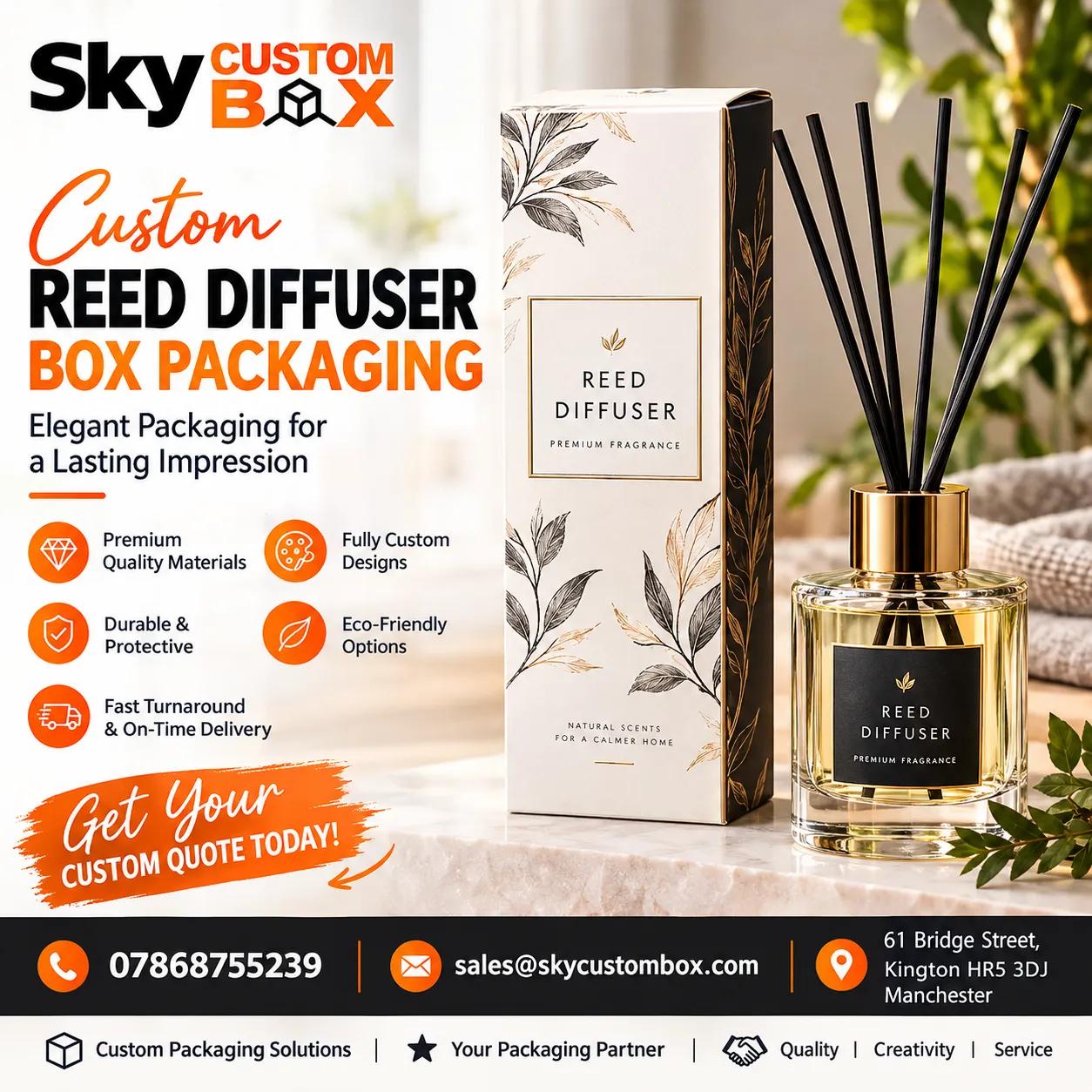
reed diffuser box packaging
Reed diffusers have become a popular way to add fragrance to homes, offices, hospitality spaces, and retail environments. Unlike products that are used and quickly replaced, a reed diffuser often remains visible for weeks or months. This makes its packaging more than a protective outer layer—it can influence first impressions, communicate product information, and contribute to the overall customer experience.
Effective reed diffuser box packaging needs to balance several priorities at once. It should protect the glass bottle and fragrance components during transportation, provide enough space for essential product information, support an appropriate visual identity, and work efficiently within retail and fulfilment environments.
For manufacturers, retailers, and independent fragrance brands, understanding these factors can help create packaging that performs well throughout the product lifecycle.
Protection Comes First
The primary purpose of any product box is protection, and this is particularly important for reed diffusers. A typical diffuser may contain a glass vessel filled with fragrance oil, along with reeds and sometimes additional accessories. Glass is vulnerable to impact, while fragrance oils can create problems if a container leaks.
A well-designed box should therefore account for the complete product configuration rather than simply matching the dimensions of the bottle.
Important considerations include:
Accurate internal dimensions: Excessive movement can increase the risk of damage during transportation.
Structural strength: The box needs to withstand stacking, handling, and movement through delivery networks.
Secure product positioning: Inserts or internal supports can help prevent bottles from shifting.
Material selection: Board thickness and construction should reflect the weight and fragility of the product.
Closure security: The box should remain closed during storage and transportation.
For premium or heavier diffuser bottles, additional internal protection may be appropriate. However, excessive packaging can increase material use, cost, and waste. The objective is to find an appropriate balance between protection and material efficiency.
Designing for Retail and Customer Experience
Packaging also acts as a communication tool. Before a customer smells a fragrance, they may interact with its packaging first. Colour, typography, imagery, texture, and structural design can establish expectations about the product.
A minimalist box, for example, may communicate simplicity and contemporary styling, while textured papers, specialist finishes, or carefully considered typography may create a more premium impression.
However, visual appeal should not compromise usability.
Good packaging design should make important information easy to identify. Depending on the market and product, this can include:
Fragrance name and scent description
Product volume
Usage instructions
Safety information
Ingredient or allergen information where applicable
Manufacturer or distributor details
Recycling information
Batch or product identification
Barcode and retail information
Clear information architecture is particularly important because fragrance products can have specific handling and safety considerations. Packaging should provide enough space for required information without making the front panel unnecessarily crowded.
Choosing Materials for Reed Diffuser Packaging
Material selection has become an increasingly important part of packaging development. Businesses are under growing pressure to consider not only how packaging looks, but also what happens to it after use.
Paperboard and cardboard are commonly used for folding cartons because they can be printed, shaped, and adapted to different structural requirements. Recyclability can also be considered during material selection, although actual recycling outcomes depend on local collection systems and the presence of coatings, laminates, adhesives, and other components.
When developing packaging, designers can ask several practical questions:
Can the box provide adequate protection without unnecessary material?
Can components be separated easily for disposal or recycling?
Are coatings and finishes appropriate for the intended end-of-life route?
Is the material strong enough for the product's weight?
Can the packaging design be produced consistently at commercial volumes?
Sustainability does not necessarily mean removing every protective feature. If a fragile glass diffuser arrives damaged, the environmental impact of the wasted product and replacement shipment can outweigh some of the material savings achieved through under-packaging.
The more useful approach is to consider the complete packaging system.
What to Consider When Ordering Wholesale Packaging
Businesses producing multiple fragrances may need packaging in significant quantities. This is where reed diffuser box wholesale solutions can become relevant. Ordering larger production runs can support consistency across a product range, but it also requires more planning.
Before committing to a wholesale packaging specification, businesses should consider:
Product dimensions
Different bottle shapes and capacities may require different box structures. A box designed around one bottle should not automatically be assumed to suit another.
Production quantities
Forecasting demand can help prevent two common problems: ordering too little packaging and having to reorder frequently, or ordering excessive quantities that remain in storage.
Branding consistency
When a fragrance collection contains several scents, packaging should allow individual products to be differentiated while maintaining a recognisable overall system.
Storage requirements
Wholesale quantities require suitable storage conditions and space. Packaging should remain clean, dry, and protected from crushing or deformation before use.
Quality control
Samples and production checks can help identify problems with dimensions, print alignment, structural strength, colour consistency, and finishing before a large quantity enters circulation.
For businesses developing several product variations, a modular packaging system can sometimes simplify production. Consistent box dimensions with controlled variations in labels, colours, or printed information may create a unified shelf presence while reducing unnecessary structural complexity.

Common Packaging Challenges and Practical Solutions
Reed diffuser packaging can encounter several problems during development and distribution. Understanding them early can prevent avoidable waste.
Problem: The bottle moves inside the box. A poorly fitted package can allow movement during transportation. Internal supports, better dimensions, or an adjusted box structure can help stabilise the product.
Problem: Packaging becomes damaged during shipping. Crushed corners or weakened panels may result from insufficient board strength, poor stacking conditions, or inappropriate carton construction. Testing packaging under realistic handling conditions can reveal weaknesses.
Problem: The design looks attractive but lacks information space. Packaging designers sometimes prioritise the front-facing appearance while leaving insufficient room for instructions and regulatory information. Planning the complete information hierarchy at the beginning avoids this issue.
Problem: Excessive packaging increases waste. Adding layers of protective material may appear safer, but unnecessary components can make the package inefficient. Structural testing can help determine how much protection is actually required.
Problem: Different products look inconsistent. A fragrance range can lose visual coherence when each package is designed independently. Establishing shared typography, layout principles, and structural dimensions can create a more unified collection.
Trends Shaping Fragrance Packaging
The fragrance packaging sector continues to reflect wider changes in retail and consumer behaviour. Several trends are particularly relevant to reed diffusers.
Minimalist design remains widely used, with brands focusing on restrained typography, uncluttered layouts, and carefully selected colours.
Material transparency is also becoming more important. Consumers increasingly want to understand what packaging is made from and how it can be disposed of.
Premium tactile finishes continue to play a role in products positioned around home fragrance and gifting. Embossing, debossing, textured stocks, foiling, and specialist printing can add visual or tactile distinction when used appropriately.
At the same time, e-commerce packaging considerations are becoming increasingly relevant. A box designed primarily for a retail shelf may face different requirements when shipped directly to consumers. Packaging may need to account for courier handling, secondary shipping cartons, dimensional efficiency, and the unboxing experience.
Companies such as Sky Custom Box can serve as examples of packaging providers operating within this broader custom packaging environment, where structural design, printing, and product-specific requirements need to work together.
Final Considerations
Effective reed diffuser box packaging is ultimately a combination of protection, communication, usability, and thoughtful material selection. The most successful packaging solutions are not necessarily the most elaborate. Instead, they are designed around the actual product, distribution conditions, customer expectations, and end-of-life considerations.
For businesses exploring reed diffuser box wholesale, careful planning is particularly important. Product dimensions, production volumes, storage, structural performance, branding consistency, and information requirements should all be considered before finalising a specification.